
Tankless Water Heater Repair FAQ
My tankless is flashing an error code — what does it mean?
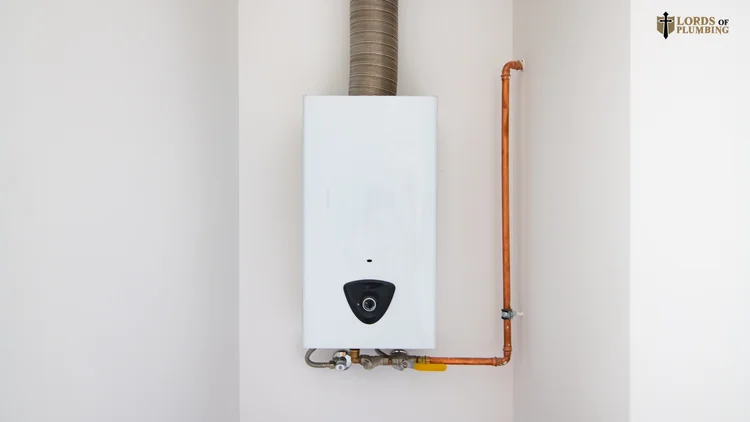
The code narrows it quickly. On Rinnai units, 11 is no ignition, 12 is flame failure after ignition, and 10 points to an air supply or exhaust blockage. Navien uses E-prefixed codes for similar faults. Write down the exact code and the model number off the label before you call, so we arrive with the manufacturer's diagnostic sequence and a manometer for that model.
How often does a tankless heater need to be flushed?
Once a year is the baseline, and every six months where water is hard. Much of Los Angeles County runs moderately hard to hard, so annual is a floor rather than a target. Descaling means circulating a food-grade acid or white vinegar through the heat exchanger with a pump for roughly 45 to 60 minutes using the isolation valves on the hot and cold connections.
What does scale actually do to the unit?
Calcium builds a layer inside the heat exchanger that behaves like insulation. The burner runs hotter to hit the same outlet temperature, the unit trips overheat or scale-detection faults, flow drops, and the exchanger fatigues from thermal stress. It is the leading cause of premature failure on these units, and the one problem a scheduled flush genuinely prevents.
My water goes hot, then cold, then hot in the shower. Is it broken?
That pattern, often called the cold water sandwich, is not always a fault. Every start has a firing delay, and the cooled water sitting in the pipe between draws reaches you first. A true fault looks different: temperature swinging mid-shower usually means scale, a fouled flow sensor, or a failing thermistor. We measure inlet and outlet temperature under a steady draw to tell them apart.
The unit won't fire at all when I open a low-flow faucet.
Most tankless units need a minimum flow, commonly around half a gallon per minute, before the flow sensor tells the board to ignite. A clogged inlet filter screen, a partially closed service valve, an aerator packed with debris, or a flow sensor fouled with scale can each drop you below that threshold. We pull and clean the inlet screen as the first diagnostic step.
It clicks and clicks but never lights.
Ignition failure has a short list: gas, spark, and air. We verify gas pressure at the unit with a manometer under load, check the igniter and flame rod for carbon fouling, and inspect the intake and exhaust for a blocked termination, a bird nest, or a crushed pipe. On a repeated no-ignition fault, stop resetting it. Shut the unit down at the gas valve and call.
Should I be worried about carbon monoxide from a tankless unit?
Enough to take blockage codes seriously. A restricted exhaust, a disconnected vent joint, or a cracked heat exchanger can spill combustion products indoors. California law requires carbon monoxide alarms in dwellings that contain fuel-burning appliances. If your alarm sounds or you get repeated exhaust-blockage faults, leave the building first, then call. We inspect the full vent run and termination, not only the unit.
Can I descale it myself with vinegar and a kit off the internet?
It is possible if your unit already has isolation valves and you follow the manufacturer's procedure exactly. What goes wrong: no isolation valves, so people cut into piping; the wrong pump or solution; and reconnecting without purging air, which can dry-fire the exchanger. Gas connections, venting, and combustion adjustment are licensed work in California under the C-36 classification. Ours is license 914119.
At what point is it not worth repairing anymore?
The line usually falls at the heat exchanger. If it is cracked or leaking on a unit past roughly 12 to 15 years, or the model is out of manufacturer parts support, replacement is the better spend. A control board, flow sensor, igniter, fan, or gas valve on a well-maintained unit is normally worth fixing. We check parts availability for your model before recommending either.
Water is dripping out of the bottom of my tankless unit.
Shut off the gas and the power before anyone opens the cover, or leave it to us. Condensing units produce acidic condensate, so a plugged condensate line or a spent neutralizer cartridge often shows as a drip with no plumbing failure at all. A leak from the exchanger itself, from a cracked fitting, or from a failed relief valve is a different repair path entirely.
How much is a tankless repair going to run me?
We diagnose before quoting. The cost drivers are which component failed, whether that part is still manufactured for your model, whether the unit already has isolation valves for service, how much scale removal the exchanger needs, and how the unit is mounted. After the diagnostic we give you the repair number in writing, and if it lands close to replacement we say so.
Do you service tankless units up in Santa Cruz, or just LA?
Both. We run service out of 5301 Beethoven St in Los Angeles for LA County and 303 Potrero St in Santa Cruz for Santa Cruz County, Los Angeles Monday through Saturday 8:00 AM to 5:00 PM and Sunday 8:00 AM to 4:00 PM, Santa Cruz Monday through Saturday 7:00 AM to 6:00 PM and closed Sunday. Have the model number and any error code ready when you call so we bring the right diagnostic material.