
Tankless Water Heater Installation FAQ
Will a tankless unit actually keep up with my house?
That comes down to temperature rise, not tank size. We take your incoming cold water temperature, subtract it from a target of about 120 degrees, and read the manufacturer's chart for gallons per minute at that rise. Two showers and a dishwasher at once is roughly 5 to 6 gpm. Santa Cruz County groundwater runs colder than Los Angeles, so the same unit delivers less flow there.
Do I need a bigger gas line to switch from a tank to tankless?
Usually yes. A 40-gallon tank heater is often around 40,000 BTU per hour, while a whole-house tankless commonly runs 150,000 to 199,000. The half-inch line that fed the tank rarely carries that. We size by total connected load and developed length using the code tables, which frequently means running three-quarter inch back to the meter, and occasionally a meter upgrade from the utility.
Can the new tankless use my old water heater's vent?
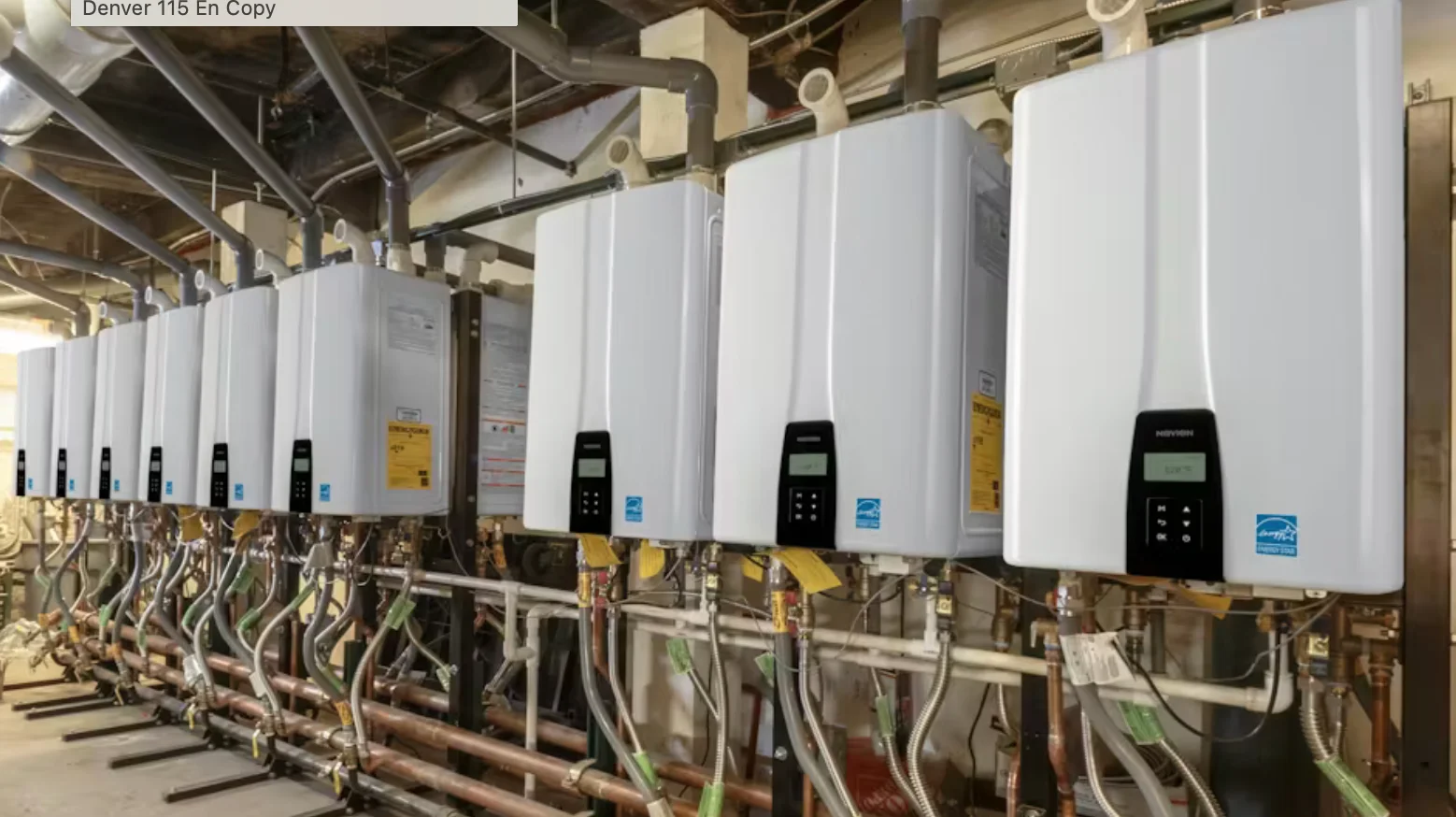
No. A tank heater's B-vent or masonry chimney is not a listed vent for a tankless unit. Condensing tankless heaters are Category IV and vent through sealed PVC, CPVC, or polypropylene. Non-condensing units are Category III and require the manufacturer's stainless steel vent. Both are typically direct vent, drawing combustion air from outside through a concentric or two-pipe termination.
What's the difference between condensing and non-condensing, and which do I want?
A condensing unit has a second heat exchanger that pulls extra heat from the exhaust, so flue temperatures drop low enough to vent in plastic and efficiency lands in the mid-90s. It produces acidic condensate that needs a drain and usually a neutralizer cartridge. Non-condensing units cost less up front, require stainless vent, and suit installations where a condensate drain is hard to reach.
Do I need a permit to install a tankless water heater?
Yes. Replacing a tank with a tankless changes the gas load, the venting, and often the water piping, so it is permitted work. In the City of Los Angeles that is a plumbing permit through LADBS, and the gas work and venting are both inspected. Unincorporated LA County and Santa Cruz County have their own building departments. Unpermitted work surfaces later during a home sale.
Where can it actually go? I want the garage wall clear.
Placement is driven by vent termination clearances, gas supply routing, and a condensate path. The manufacturer sets minimum distances from windows, doors, soffits, and air intakes, usually measured in feet, and the vent cannot terminate under a deck or into a recessed alcove. In a garage the ignition source generally must sit 18 inches above the floor unless the unit is listed otherwise.
Is it worth switching from my tank, or should I just put in another tank?
Tankless makes sense when you run out of hot water, want the floor space back, or your tank is at end of life anyway and the gas and vent work is feasible. It makes less sense in a condo with no exterior wall, or where the gas supply cannot carry the load. We look at your gas line, vent path, and actual hot water demand before recommending either.
Does hard water mean I need something extra installed with it?
Across much of Los Angeles County the supply runs moderately hard to hard, which drives scale into the heat exchanger. At installation we add isolation valves, also called service valves, with hose ports on the hot and cold connections so the unit can be flushed later without cutting pipe. Some homeowners add a scale inhibitor or softener. Skipping the isolation valves makes every future service more expensive.
Why does it still take so long for hot water to reach my bathroom?
Tankless heats on demand, but the cold water already sitting in the pipe still has to clear before hot arrives, and there is a short firing delay at startup. Distance is the real variable. If the fixture is far from the unit, we look at a recirculation setup, either a dedicated return line or a pump with a crossover valve at the far fixture.
Do I need electrical work done too?
Yes, gas tankless units need power. Most residential models plug into a dedicated 120-volt receptacle that runs the fan, controls, and igniter, which also means no hot water during a power outage unless you have a generator. Electric tankless is a different matter, often needing multiple high-amperage 240-volt circuits and a service panel that can carry them. We confirm receptacle location during the site visit.
What will this cost to install?
There is no useful number before we see the site. The drivers are gas line size and length, whether the meter can carry the added BTU load, the vent path and how many walls it crosses, condensate drainage, water piping changes, the permit and inspection, and whether the old tank has to be hauled out and the wall patched. We scope it, then price it in writing.
How long does the install take and will I lose hot water?
A straightforward tank-to-tankless conversion is generally a one-day job. It stretches when the gas line has to be resized back to the meter, the vent has to cross finished walls, or a recirculation line goes in. Water is off for part of the day. The inspection happens afterward, and we schedule that with LADBS or your local building department.