


Drain and Sewer Repiping: Common Questions
What is a drain repipe, and how is it different from a copper repipe?
A drain repipe replaces the drain, waste, and vent piping, meaning everything that carries water away from fixtures, including branches, stacks, vents, and the building drain. A copper repipe replaces the pressurized supply lines bringing water in. The two systems fail differently. Supply lines develop pinhole leaks under constant pressure; drain lines rust, scale, and lose grade, and they only leak while a fixture is running.
How does cast iron drain pipe actually fail?
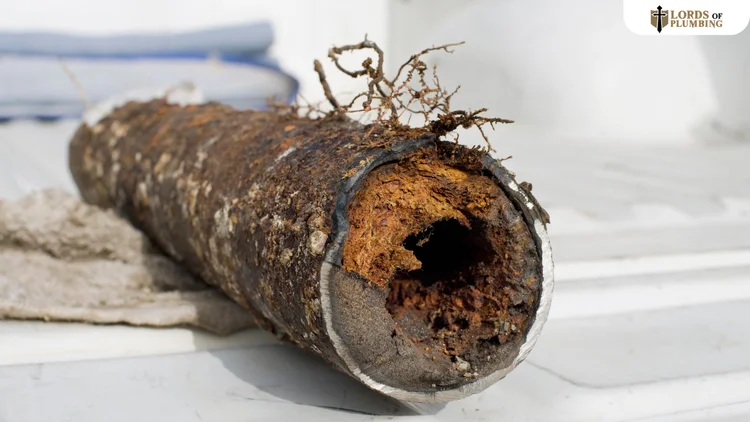
From the inside. Waste sits along the bottom of a horizontal run, so corrosion channels a groove at the six o'clock position until it opens through the wall. Above the water line, rust builds as tuberculation and narrows the diameter. Hub joints packed with oakum and lead loosen as the metal moves. Most cast iron drain piping in Los Angeles homes predates 1970 and is well into that curve.
Should I replace cast iron with ABS or with more cast iron?
ABS Schedule 40 meeting ASTM D2661 is the common residential choice in Los Angeles: it does not corrode, joints are solvent welded, and it is lighter to handle in a tight crawlspace. Hubless cast iron to ASTM A888 with CISPI 301 couplings is still specified where sound transmission matters, such as a stack behind a bedroom wall, or where an assembly needs the mass. Both are code-approved.
Do you have to break my slab?
For lines cast under a slab-on-grade, usually yes. We locate with a camera and sonde, saw-cut only the marked path, and set up dust containment. Post-tensioned slabs get scanned before any cutting, because a severed tendon becomes a structural repair. Where fixture layout allows, an overhead reroute through the attic or an exterior reroute can avoid the slab entirely. The layout decides that, not preference.
Why are you adding vents? The old pipes worked.
Older houses were often piped before current venting rules, then remodeled without vents being added. Chapter 9 of the California Plumbing Code sets how far a trap can sit from its vent and how vents are sized and combined. Without enough venting, a draining fixture siphons water out of nearby traps, sewer gas enters the room, and drains gurgle. A repipe is when that gets corrected, since walls are already open.
Can we stay in the house during a repipe?
Usually, when the work is phased. We sequence by stack or by bathroom so at least one bathroom and the kitchen stay usable most days, and we tell you the night before which fixtures go offline. Full under-slab replacement in a single-bathroom house is the case where people typically move out for a few days. Floors and walls stay open until the inspector signs off.
What permits and inspections apply?
LADBS issues plumbing permits for installation or modification of drainage, waste, and vent systems, so a repipe is permitted work with a rough inspection before anything gets covered. The new piping is pressure tested for that inspection, typically a water test with a 10-foot head or an air test, and the inspector verifies grade, materials, and venting. We pull the permit under CSLB #914119.
How do I know I need a repipe rather than another cleaning?
Camera evidence. Repeat stoppages in different branches rather than one location point to system-wide loss of diameter. Look for channeling through the bottom of the pipe, sections holding water, roots at several joints, and rust flakes returning on the cable. If cleaning restores flow for years and the camera shows sound pipe, keep cleaning. If the pipe wall is gone, cleaning only defers the repipe.
Why is slope such a big deal?
Because drains move waste by gravity, not pressure. The California Plumbing Code calls for horizontal drainage piping to fall about 1/4 inch per foot, with 1/8 inch per foot permitted on 3-inch and larger lines under specified conditions. Too little slope and solids drop out. Too much and water outruns the solids, leaving them behind. A sagging section, called a belly, holds standing water and clogs repeatedly.
What determines the cost of a drain repipe?
Linear footage and how the piping is reached. An accessible crawlspace is a very different job from concrete cutting or an attic reroute. Fixture count, number of stacks, number of stories, pipe material, vent corrections required by code, permit and inspection time, and whether finished surfaces must be opened and patched all move the number. We camera the system and walk the house before quoting a firm price.