

When more than one fixture backs up together, the problem is usually in the building sewer rather than a single fixture trap. The check is a camera run from the cleanout to the connection at the public main. That footage shows whether the cause is roots, a break, or a sag, and it decides which repair actually applies.
We run a camera the full length of the lateral from the cleanout to the main and record distance as the head travels, so a defect can be located in feet from the access point. Pipe material and diameter get noted at the same time. Nothing gets quoted until that footage exists, and you watch it with us.
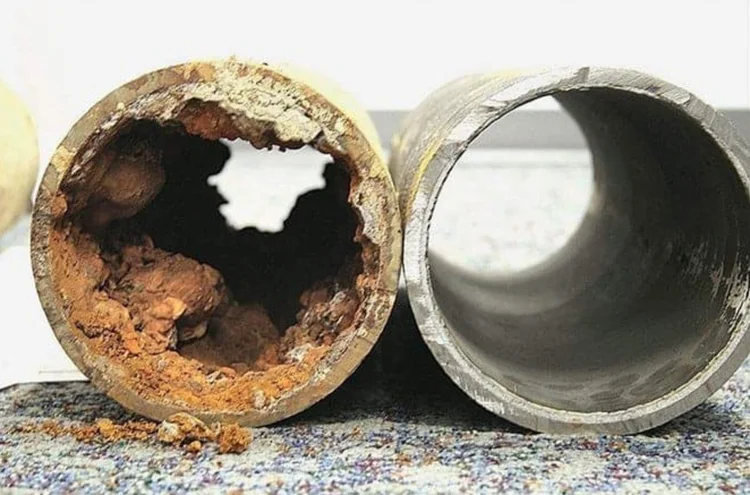
Around here you mostly find vitrified clay in pre-1970s neighborhoods, cast iron under older homes, Orangeburg in some 1950s tracts, and ABS or PVC in anything newer. Clay fails at the joints and lets roots in, cast iron corrodes from the inside, and Orangeburg deforms out of round. Material drives whether lining or replacement makes sense.
Often, yes. Cured-in-place lining follows ASTM F1216, where a resin-impregnated tube is inverted into the existing pipe and cured to form a new wall inside it. Pipe bursting pulls a new HDPE pipe through the old one from two access pits. Both methods need a host pipe that still holds its line and grade.
Excavation is the answer when the pipe has lost grade. A sag holds standing water, and lining a sag only preserves it at a smaller diameter. The same applies to a full collapse, a badly offset joint, or a section that has separated. Those need the trench opened and the pipe re-bedded to the correct fall.
Roots enter at joints and cracks, not through sound pipe, so cutting them only buys time until they grow back. The lasting fix is removing the entry point, either by lining the run so there are no open joints or by replacing the damaged section. Cleaning first, then a camera pass, confirms where the entries are.
Lateral work in the Santa Cruz County Sanitation District area goes through the County Department of Public Works Sanitation Division, and a County inspector has to view the open excavation before it is backfilled. Inspections are scheduled through the Sanitation Division at (831) 454-2895, and the County asks for roughly 48 hours advance notice.
The property owner maintains and repairs the building sewer for its whole length, including the portion running under the sidewalk or street out to the public main. City of Santa Cruz Municipal Code 16.08.060 states this directly, and the County Sanitation District takes the same position. Only the public main itself belongs to the agency.
Cost tracks the length of pipe involved, its depth, the material, whether the run crosses a driveway, sidewalk, or a neighboring property, and whether lining will hold or the trench has to be opened. Permit and County inspection requirements factor in as well. You get a firm price after the camera inspection, before any work starts.
Yes. Our Santa Cruz office at 303 Potrero St, Bldg 42 #104 covers Santa Cruz County, including Capitola, Live Oak, Soquel, Aptos, Scotts Valley, Watsonville, and the San Lorenzo Valley. Requirements differ by agency, since the County Sanitation District, the City of Santa Cruz, and the City of Scotts Valley each administer their own sewer systems.